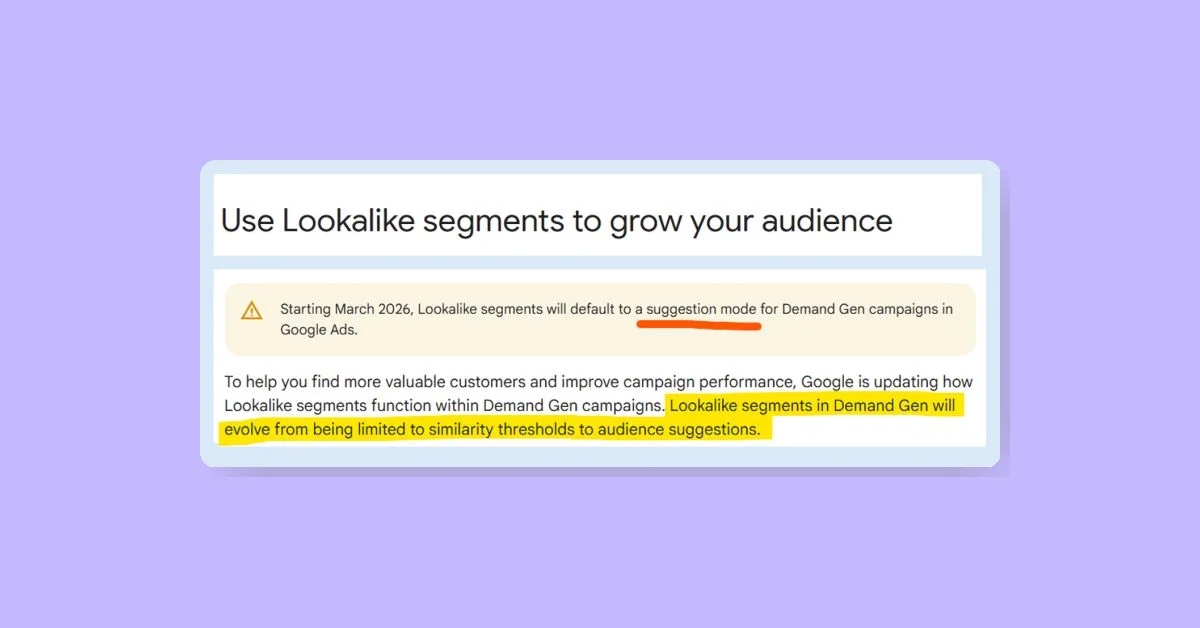
Starting March 2026, Google will change how Lookalike audiences function in Demand Gen campaigns by shifting from strict similarity-based targeting to an AI-driven suggestion model. Previously, advertisers uploaded a Lookalike audience with a set similarity level (narrow, balanced, or broad), and the system targeted only users within that Lookalike list. After the update, the system will use the seed list and selected reach level as signals, allowing it to target users beyond the similarity threshold who are likely to convert, optimizing for conversions and CPA.
Key Changes and Details
- Lookalike as a Suggestion: Instead of a strict targeting constraint, Lookalike segments will act as suggestions, enabling broader reach through AI optimization.
- Optimized Targeting Compatibility: Lookalike as a suggestion complements, but does not replace, Optimized Targeting. When both are enabled, they can expand audience reach further.
- Legacy Lookalike Audiences: Advertisers wishing to maintain strict Lookalike targeting can still do so by submitting a request via a form.
Reasons Behind the Change
Google likely aims to avoid performance limitations caused by strict Lookalike targeting and to leverage automation to compensate for challenges in creating high-quality Lookalike audiences. This approach aligns with Meta’s recent shift toward AI-based targeting, trading some control for potentially improved campaign performance.
Overall, while this update may reduce granular control, it is expected to enhance campaign outcomes by allowing more flexible, AI-optimized audience targeting.