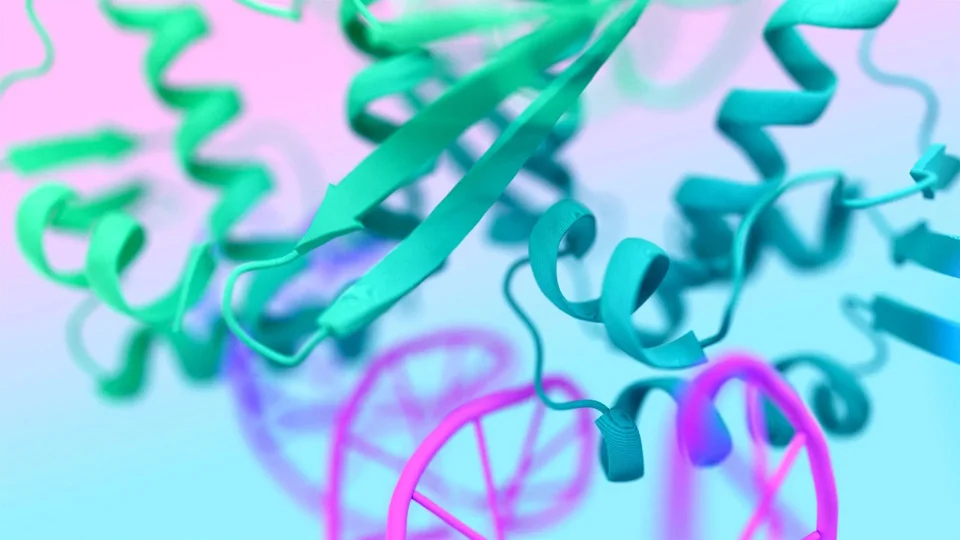
Google DeepMind has released an updated version of AlphaFold, a machine learning model predicting protein shapes and behaviors. AlphaFold 3 is more accurate and predicts interactions with other biomolecules, enhancing its versatility as a research tool. A limited version is now available for free online use.
AlphaFold has been the leading method for predicting protein structure from amino acid sequences since its 2018 debut. It's critical to biology, and computational modeling techniques like AlphaFold have replaced expensive lab-based methods, accelerating research across various fields.
AlphaFold 3 can simulate multiple molecules at once, including proteins interacting with other proteins and biomolecules like DNA and RNA strands. However, the technology is still evolving.
AlphaFold Server, a free, fully hosted web application, is now available for non-commercial use. Users need a Google account to access the service. Despite being a significant investment for Google, the technology is expected to be profitable through Alphabet subsidiary Isomorphic Labs, which uses AlphaFold in drug design and has partnerships with Eli Lilly and Novartis.
While AlphaFold is a valuable tool, it's not the ultimate solution in biology. It enables scientists to create and test hypotheses at the atomic level and produce accurate structure predictions within seconds, compared to the months or years it might take experimentally.
Critics argue that this isn't a win for open science as AlphaFold's training process and other crucial information for replication are largely withheld. Scientists wanting to use the tool will have to do so under Alphabet, Google, and DeepMind's supervision. Despite this, many researchers are expected to utilize the free AlphaFold Server.