Meta has launched the AI Developer Assistant for WhatsApp Business developers and tech providers to simplify onboarding. This AI tool offers contextual guidance, troubleshooting, and answers based on official documentation, helping with app configuration, business verification, and app review. It is integrated into onboarding flows and is being rolled out to all developers by mid-June to speed up setup and launch.
Meta introduces the ads CLI, a command-line tool for managing Meta ad campaigns without custom code. It simplifies repetitive tasks like authentication and pagination, supports multiple output formats, and integrates into workflows. Users can create, update, and analyze campaigns, ad sets, creatives, catalogs, and datasets from the terminal. Designed for automation, it supports scripting, exit codes, and environment variables. Requires Python 3.12+.
Facebook updates Developer Policies to improve ad-buying transparency and account structure. Advertisers must keep end advertisers in separate ad accounts unless using vendor_id or brand fields properly. From February 3, 2027, ad-buying solutions must disclose ad spend, fees, and campaign details upon end advertiser request. Meta may disclose info if policy violations are suspected, without prior notice. These changes align with industry standards.
Instagram API updates enhance branded content workflows, adding partnership ads labels with or without brand tags. New engagement metrics include reposts, saves, shares, and aggregated views, likes, and comments across Instagram and Facebook. Collaborative media endpoints allow tracking co-created content. The API now supports liking/unliking posts and comments via third-party apps with proper permissions.
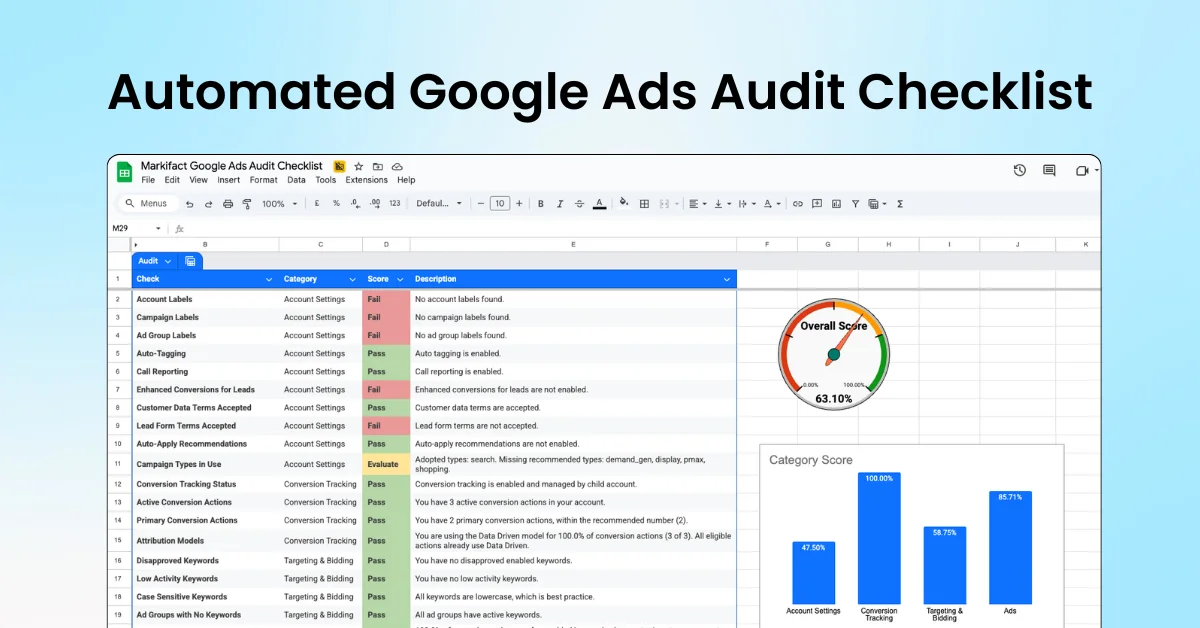
Run an automated Google Ads audit directly from Google Sheets with 40+ built-in checks. Review campaigns, ad groups, keywords, ads, and account settings to catch missed best practices and optimization gaps. Ideal for agencies and in-house teams to standardize audits, save hours of manual work, and turn findings into clear, actionable recommendations.
Starting June 22, 2026, Facebook will replace Nielsen's DMA with Comscore Markets® for automotive ads. Campaigns using Nielsen’s DMA will pause until updated. From March 23, 2026, advertisers can update vehicle offer feeds with Comscore Market IDs using a provided mapping table. Notifications begin April 20, and all Nielsen DMA targeting ends June 22. Updates via Catalog Manager or API are required to resume campaigns.
Threads API now offers richer content options such as cross-sharing to Instagram Stories, long-form text attachments, ephemeral ghost posts, spoiler tags, and GIFs. It supports tokenless embedding, enhanced web intents for posting, and improved search by media or author. New management tools include reply approvals and real-time webhooks for post events. Developers can use documentation, sample apps, and testing tools for integration.
Threads has over 400 million monthly users and now supports App Ads globally via the Marketing API, allowing app install and event optimization campaigns without new creatives. A new reply moderation tool lets advertisers view, hide, and respond to top-level replies on Threads ads, requiring specific permissions. More details and updates are in the developer documentation and changelog.
Facebook Graph API v25 adds Page Viewer Metric replacing legacy reach by June 2026, requiring migration. Webhooks mTLS certificates change to Meta CA by March 31, 2026, needing trust store updates. Ads Insights Async API adds error details. Metadata=1 parameter deprecated. Legacy reach and viewer metrics retire by June 2026, replaced by Media Views. Marketing API phases out ASC and AAC campaigns by Sept 2026. Graph API v19 and v20 deprecated in 2026.
Facebook is phasing out ASC and AAC campaigns in Marketing API starting V25.0 (Feb 18, 2025), with creation and updates disabled, extending to all MAPI versions after 90 days. By V26.0 (Sep 2026), remaining ASC and AAC campaigns will be paused. ECBC campaigns remain editable until V26.0 but must be duplicated or migrated before then. New campaigns get new IDs. Developers should review updated docs for details.